The Coffee Shop Effect: Why Cafés Are Becoming the New Temples of Consumer Culture
There was a time when coffee was simply fuel.
Today, it is identity.
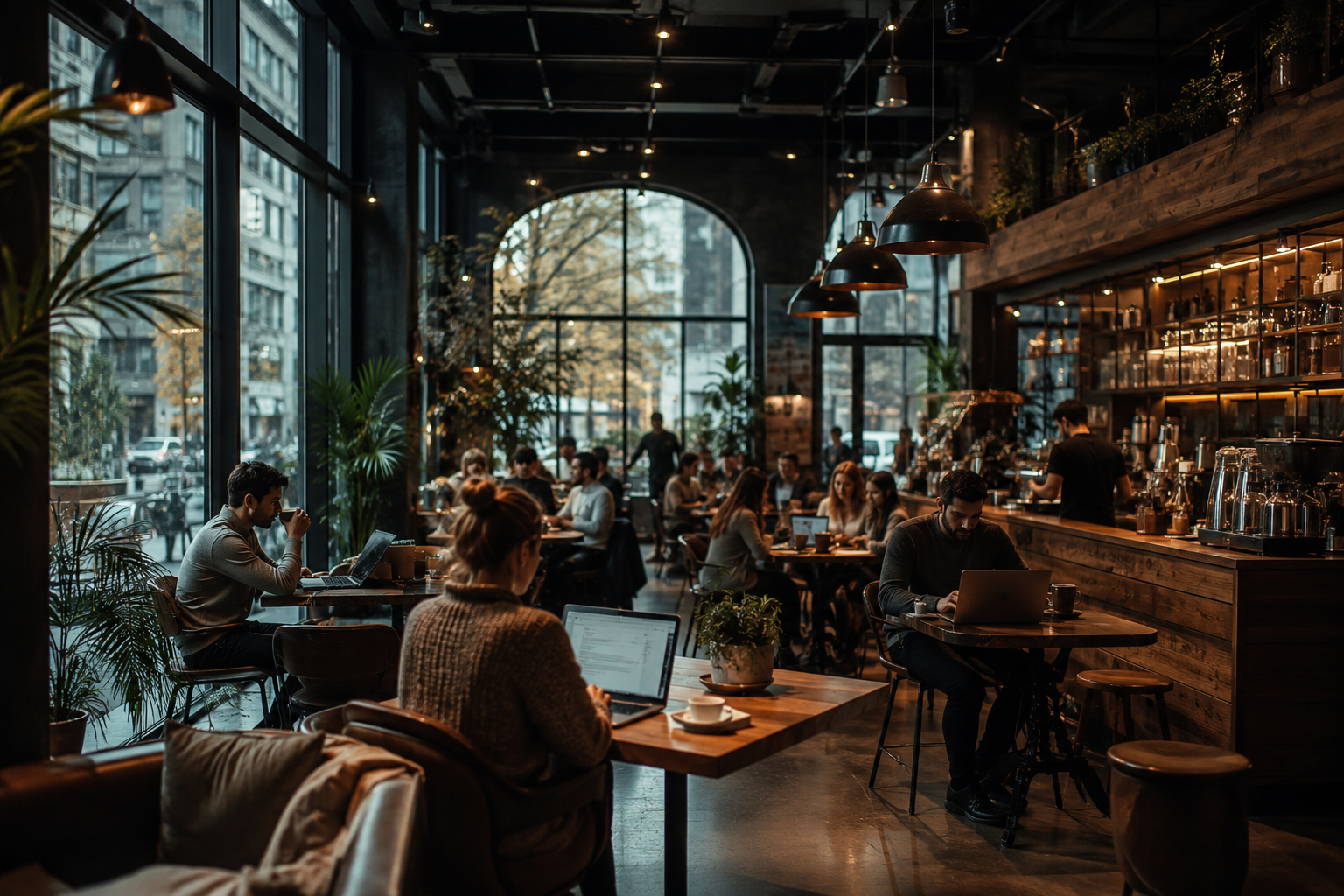
Across major cities worldwide, coffee shops have evolved from places that serve beverages into cultural institutions that shape how people work, socialize, consume, and even define themselves.
The phenomenon has become so widespread that it deserves its own name: The Coffee Shop Effect.
Far beyond caffeine consumption, this trend reveals a profound transformation in consumer psychology, the evolution of modern communities, and the growing role of brands in satisfying needs that were once fulfilled by religion, family structures, and local institutions.
The rise of the coffee shop may be one of the most revealing stories of our time.
Because it tells us less about coffee than it does about what people are searching for.
The Age of Consumption Is Over. The Age of Meaning Has Begun.
For most of the twentieth century, consumers purchased products primarily for their utility.
A chair was a chair.
A watch told the time.
Coffee provided energy.
Today, functionality is no longer enough.
Consumers increasingly expect products and services to express values, reinforce identity, and create emotional experiences.
Economists call this the transition from the product economy to the experience economy.
But what we are witnessing goes even further.
We are entering what some sociologists describe as a meaning economy, where consumers purchase symbols, stories, and belonging as much as physical goods.
A $5 coffee is rarely about coffee.
It is about what that coffee says about the person holding it.
Ethical.
Creative.
Productive.
Urban.
Conscious.
Successful.
In a world where identity is increasingly self-constructed, consumption has become one of the primary languages through which people communicate who they are.
The Search for a New “Third Place”
One of the most influential concepts in urban sociology is the idea of the Third Place, developed by Ray Oldenburg.
The First Place is home.
The Second Place is work.
The Third Place is where society happens.
Historically, these spaces included churches, community centers, public squares, neighborhood clubs, and local gathering spots.
Yet many of these institutions have weakened over the last decades.
Religious participation has declined across much of the Western world.
Community organizations attract fewer members.
Families are smaller and more geographically dispersed.
Remote work has reduced daily social interactions.
At the same time, loneliness has become one of the defining public-health challenges of the twenty-first century.
According to global studies, feelings of social isolation have increased significantly across many developed and emerging economies.
Humans, however, have not changed.
The need for belonging remains.
And nature abhors a vacuum.
As traditional institutions retreat, coffee shops are increasingly stepping forward.
They provide something rare in modern society:
The ability to be together without obligation.
You can enter alone.
Stay for hours.
Speak to nobody.
Yet still feel connected.
This subtle social comfort may explain why coffee shops continue expanding even in highly digital societies.
Ritual in an Age of Uncertainty
Every civilization creates rituals.
For centuries, rituals were anchored in religion, family traditions, or community life.
Today, many consumers create rituals through brands.
Consider the modern coffee routine.
The same café.
The same order.
The same seat.
The same barista.
The same music.
The same cup.
From a psychological perspective, rituals create stability.
Researchers consistently find that repetitive behaviors reduce anxiety and provide a sense of control during periods of uncertainty.
In an increasingly volatile world—economically, politically, technologically—the daily coffee ritual functions as a small island of predictability.
People do not merely consume coffee.
They perform coffee.
And every ritual reinforces identity.
The customer is not simply ordering a cappuccino.
The customer is reaffirming a version of themselves.
Is Coffee the New Religion?
The question may sound provocative.
Yet the parallels deserve examination.
Traditional religions historically offered five essential functions:
- Meaning
- Community
- Ritual
- Identity
- Shared values
Modern coffee culture increasingly provides surprisingly similar experiences.
The café becomes the gathering place.
The morning visit becomes the ritual.
The brand embodies values.
The community forms around shared behaviors.
The product becomes symbolic.
Of course, coffee is not replacing faith.
But it is helping fill certain social and psychological spaces left vacant by declining institutional participation.
French philosopher Gilles Lipovetsky once described contemporary society as an era of “hyper-consumption,” where people increasingly seek emotional and existential satisfaction through market experiences.
Coffee culture may be one of the clearest manifestations of that shift.
Why Gen Z Is Driving the Movement
No generation has embraced coffee culture more enthusiastically than Generation Z.
This is not accidental.
Gen Z came of age during a period marked by:
- Economic uncertainty
- Social media saturation
- Pandemic isolation
- Rapid technological disruption
- Declining trust in institutions
As a result, younger consumers often place greater value on authenticity, community, and experience than previous generations.
A coffee shop offers all three.
It provides a physical environment in an increasingly digital world.
A social atmosphere without social pressure.
A sense of participation without long-term commitment.
For many young professionals, cafés have become offices, networking spaces, meeting rooms, creative studios, and social hubs simultaneously.
Few environments deliver so many functions at such a low cost of entry.
The Marketing Lesson Nobody Should Ignore
The Coffee Shop Effect contains one of the most important lessons in modern marketing:
People do not buy products.
They buy transformation.
Consumers are no longer asking:
“What does this product do?”
They are asking:
“What does this product say about me?”
The brands winning today understand that value is increasingly emotional rather than functional.
The most successful businesses create:
- Rituals instead of transactions
- Communities instead of audiences
- Meaning instead of messaging
- Belonging instead of loyalty
This explains why some customers willingly pay ten times more for a premium coffee experience than for coffee prepared at home.
The beverage is not the product.
The experience is.
The identity is.
The feeling is.
The Rise of Brand Temples
Historically, temples, churches, and public monuments served as physical representations of shared beliefs.
Today, brands are increasingly building their own symbolic spaces.
Apple Stores.
Flagship fashion boutiques.
Luxury fitness clubs.
Premium coworking spaces.
Specialty coffee shops.
Each functions as a physical expression of a worldview.
Consumers enter not merely to purchase.
They enter to participate.
The strongest brands no longer compete on price or features alone.
They compete on meaning.
Coffee shops mastered this years ago.
Many other industries are only beginning to understand it.
What Comes Next?
The future café may resemble a community platform more than a beverage retailer.
Already, coffee shops are blending hospitality, coworking, wellness, networking, retail, education, and entertainment.
Artificial intelligence may automate many services.
Remote work may further decentralize offices.
Digital interactions may continue replacing physical ones.
Paradoxically, these trends could make human-centered spaces even more valuable.
The Coffee Shop Effect suggests that the future of innovation may not be purely technological.
It may be deeply human.
Because behind every latte sold lies a timeless need:
To belong.
To connect.
To find meaning.
And increasingly, consumers are discovering all three in places that were once known simply as cafés.
Trend Insight
The companies that will dominate the next decade may not be those that sell the best products.
They may be those that create the strongest rituals, the deepest communities, and the most meaningful experiences.
Coffee shops just happened to show us the future first.
Author

Kettely BLARY
Kettely Blary is a founder with a distinctive approach, driven by a deep interest in how ideas evolve—from their earliest spark to their full realization in the tangible world. The author of To Make a Faun Sit and Mapipis, she explores in both her writing and her projects the moment when intuition takes shape—when something abstract becomes real and embodied. As the head of KB Ayilink, she develops and leads projects that carry ideas beyond their original scope. Her work reflects a strong sense of balance between structure and movement, intention and execution, and individual expression and collective dynamics. Across everything she does, she is guided by a simple belief: ideas truly come into their own when they find their most compelling form in the real world.