What African Markets Teach Us About Innovation

A market trader accepts a mobile payment, a repairer keeps an older device useful, and a customer combines an app with a call or an in-person conversation. None of these scenes represents “Africa” as a whole. Together, they point to a better way of discussing innovation in African markets: begin with specific conditions, observe how formal and informal systems interoperate, and design for trust, affordability and continuity.
The continent contains 54 countries, many regulatory environments, thousands of languages and sharply different infrastructures. The useful lesson is not that constraint magically produces ingenuity. It is that teams who take real constraints seriously often build services with flexible access, human fallbacks and practical value. That discipline can improve innovation anywhere.
Innovation in African markets begins with specificity
“The African consumer” is not a usable design subject. A commuter in Johannesburg, a small retailer in Windhoek, a farmer outside Nakuru and a freelancer in Maputo may share a mobile device yet face different prices, payment rails, languages, distances and institutions. Even within one city, income, disability, age, migration and connectivity create different service realities.
Replace continental claims with a location, a task and a moment. Ask how a person pays a supplier in a specific market, finds a verified repairer, receives a health result or resolves a failed transfer. Then map the actors, rules, costs and workarounds around that task. Specificity makes comparison possible without pretending that one example speaks for everyone.
This approach also changes research partnerships. Local experts should define the question, interpret observations and share ownership of the conclusion. Their role is not to decorate an external thesis with colourful anecdotes. Responsible learning names origins, limits transfer and asks who benefits when an insight becomes a product.
Constraint-aware design is not the romance of scarcity
Designing with constraints means treating bandwidth, electricity, device memory, data price, distance and cash flow as product requirements. It does not celebrate unreliable infrastructure or ask people to remain resourceful forever. A broken system is still a burden. The objective is to make a service useful now while supporting better underlying conditions.
The GSMA's Mobile Economy Africa 2025 describes a large usage gap: many people live within network coverage but do not use mobile internet, with device affordability and digital skills among the barriers. Coverage alone is therefore a poor proxy for access. A strategy based only on a coverage map can miss the cost of a handset, charging, identity documents, data and confidence.
Teams should define a minimum viable environment: the least capable supported device, the weakest expected connection, the longest reasonable interruption and the available support channels. Test there before polishing the ideal path. A lightweight page, resumable task, clear USSD flow or printable confirmation may create more value than a feature that works only on a recent smartphone.

Editorial illustration: repair and maintenance reveal the value of designing for longevity.
Repair is a service pattern, not a picturesque scene
Repair economies show how value continues after purchase. Spare parts, diagnostic knowledge, informal referrals and skilled hands extend the life of devices that a linear product model would discard. For an innovation team, the lesson is operational: can a product be diagnosed, maintained, transferred and recovered without depending on a distant centre?
Design documentation for technicians as well as end users. Make error states identifiable, replacement parts findable and account recovery possible when a device changes hands. Consider what happens when an authorised channel is absent. A tightly controlled ecosystem may protect quality in one context while making a product unusable in another.
Do not appropriate repair as an aesthetic of improvised wires and heroic scarcity. Speak with practitioners about safety, warranty, earnings and access to parts. Innovation is not the photograph of a workaround; it is the redesign that removes avoidable hardship while preserving local skill and agency.
Mobile-first should mean task-first
“Mobile-first” is often translated into a responsive screen. In practice it should prioritise the task under mobile conditions: small screens, shared devices, intermittent sessions, costly data, limited storage and varied digital confidence. A beautiful application that requires a large download and constant connection may be less mobile than a focused web flow with SMS confirmation.
Offer progressive paths. A person might discover a service through messaging, compare on the web, confirm with USSD and seek help by phone. Preserve context between those channels. Do not make the user restart because the organisation divides digital, call-centre and field operations into separate departments.
The World Bank Global Findex 2025 figure set shows why device and account assumptions need care: basic-phone and smartphone access are not distributed equally, and ownership does not guarantee that a SIM or account is personally controlled. Research privacy on shared phones, notification visibility and the consequences of losing a handset.
Interoperability is part of the user experience
A service can be elegant inside its own boundary and frustrating at the edge. Money has to move between wallets, banks and merchants; identity has to be recognised; records have to survive a channel switch. Interoperability is not only an infrastructure concern. It determines whether a customer can complete an ordinary task without recruiting an intermediary.
Namibia offers a specific policy example. The Bank of Namibia's payment-system directives include a directive on e-money interoperability through an instant payment switch. Its stated rationale connects shared infrastructure with faster, more affordable payments and financial inclusion. This does not describe every Namibian experience, but it demonstrates that product convenience can depend on rules and rails beyond one interface.
In Kenya, Safaricom reports that Lipa na M-PESA merchant payments became network-agnostic , allowing payment from other networks. The strategic lesson is not to copy M-PESA into a different market. It is to examine where closed loops create friction and where standards, APIs or partnerships can make a service more useful.
Formal and informal systems often work together
People do not wait for a formal platform before organising trust. They ask neighbours, use messaging groups, keep paper records, extend credit to known customers and rely on intermediaries who understand local conditions. A digital service that labels these practices obsolete may destroy the intelligence it needs.
Map the existing trust network before proposing replacement. Who introduces whom? What evidence counts? How is a dispute handled? Which records are private, and which are intentionally social? Digitisation may improve discoverability or traceability while leaving room for human judgement. It can also concentrate power, expose sensitive relationships or impose fees on an exchange that was previously flexible.
The design goal is not “formalise everything.” It is to make responsibilities and protections clearer while respecting useful social infrastructure. A provider may want a business record without exposing every customer. A customer may value community referral and still need an independent complaint path. Hybrid design treats those needs as compatible.
Trust must be engineered into the transaction
Trust is not a campaign line added to a marketplace. It is the ability to judge an offer, understand the exchange and recover when it fails. Profiles need current information; verification badges need explained standards; prices need scope; reviews need safeguards; and support needs authority to act.
A badge can create dangerous confidence if users do not know what was checked or when. State the verification boundary in plain language. Distinguish identity, qualification, availability and performance rather than collapsing them into one tick. Give both customer and provider a way to correct data and contest a decision.
Ayivoo is a locally grounded example of a platform concerned with connecting people and service providers in Namibia. The editorially relevant question is how discovery, context and confidence can be designed together; no marketplace should be treated as proof that trust work is finished. The principles in technology and trust remain essential after launch.
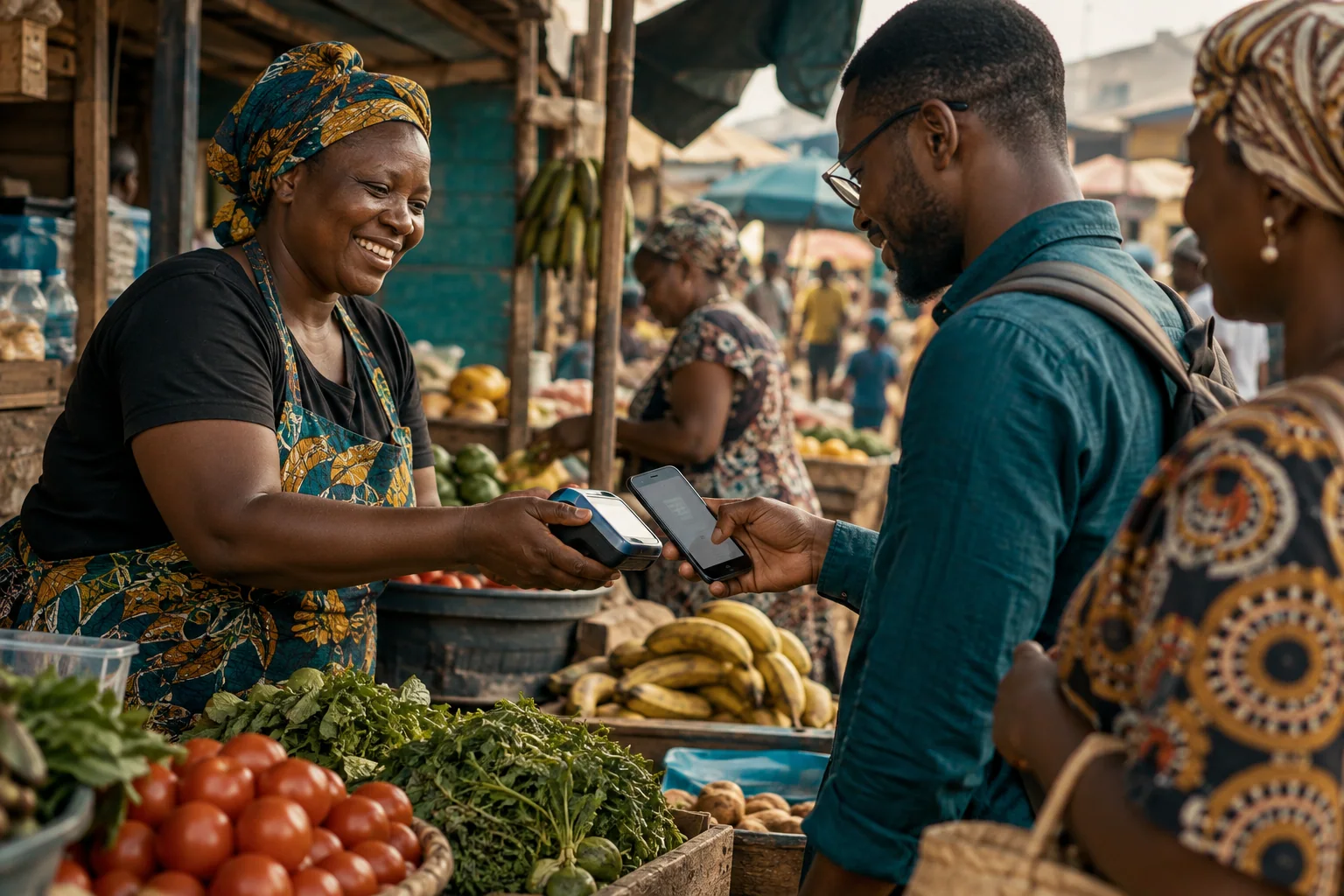
Editorial illustration: digital payment works best when roles, amount and next steps are clear.
Cash, digital payment and human help can coexist
A binary story in which digital replaces cash ignores why people use each method. Cash can be immediate, visible and widely accepted; digital payments can support distance, records and reduced handling. Each carries risks. Good services let the task, regulation and user circumstances shape the mix.
Design the confirmation, not only the payment button. Both parties should see the amount, recipient, status, fees and reference. A pending transaction must look different from a completed one. When connectivity fails, the interface should not encourage repeated payment attempts. Provide a route to reconcile conflicting records.
Human help is especially important when money, identity or livelihood is involved. Publish support hours and expected response, retain transaction context and allow escalation beyond a scripted answer. Automation may triage common cases, but a person needs authority to investigate exceptions. Service recovery is one of the strongest tests of whether a financial innovation deserves trust.
Design for language, literacy and shared use
Language choice is not a dropdown added after build. Vocabulary, sentence structure, audio, numerals and examples affect whether a person can act safely. Research the terms people use for the task; do not assume a direct translation of institutional language. Test with speakers who vary in literacy and familiarity, not only professional translators.
Icons do not create a universal language. A symbol can be unknown or carry a different meaning. Pair important icons with words, make consequences explicit and use progressive disclosure for detail. Voice can assist some people but may reduce privacy on a shared device or in a public setting. Offer alternatives rather than a single “inclusive” channel.
Shared use requires careful account design. Avoid revealing balances or sensitive categories in notifications. Make sign-out clear. Let a person control what remains visible. If assisted use is common, distinguish legitimate help from coercion and define consent at each consequential step.
Build distribution and operations with the product
A service is not available merely because it is online. People must hear about it from a credible source, understand its relevance, afford access and find help nearby. Agents, merchants, community organisations and field teams can be part of the experience, but their incentives and workloads shape quality.
Prototype the operating model alongside the interface. Who updates provider details? Who handles a disputed payment? What happens outside office hours? How are agents trained when the product changes? A feature that creates unmanageable support volume is not finished. Neither is a campaign that generates demand where supply is thin.
This is where digital platform design meets operations and ordinary experience design . The handoff from screen to person, the wait for confirmation and the quality of a receipt are not secondary details. They are the service.
Measure inclusion as successful use
Downloads, registrations and accounts can conceal exclusion. Measure whether people complete the task, understand the result and return without avoidable help. Segment carefully by device, channel, location and relevant access needs, while collecting no more personal data than necessary.
Look for abandonment at verification, repeated retries, unresolved pending states, support escalation, agent distance and failed recovery. Pair quantitative patterns with interviews. A low completion rate may reflect confusing copy, missing documents, mistrust, unaffordable data or a service that solves the wrong problem. The metric locates a question; it does not explain the person.
Include provider outcomes. Faster customer discovery means little if fees, delayed settlement or arbitrary suspension make participation unsustainable. An inclusive marketplace distributes clarity, recourse and value across sides. Governance must hear people with the least leverage, not only the largest partners.
A field framework for responsible learning
Before borrowing an idea from an African market, document six things:
- Place: the exact geography, sector and population observed.
- Problem: the task and burden, in the words of affected people.
- System: formal rules, informal practices and infrastructure involved.
- Power: who decides, pays, carries risk and receives value.
- Evidence: what is known, what is inferred and what remains uncertain.
- Transfer: which conditions must be present elsewhere.
Add local review before publication or investment. Compensate expertise. Attribute the origin of a practice. If commercial value follows, build a fair relationship rather than extracting an anecdote. This is both ethical and strategically sound: context stripped away from an idea is often the part that made it work.
Leave room for refusal and repair
Participation is not inclusion if the service makes refusal costly. Let people understand the offer before creating an account, decline optional data uses without losing the core task and leave with their records where feasible. A community partner should not be pressured to endorse a product merely because it hosted research.
Plan repair at three levels. The interface corrects an input or reverses a safe action. Support resolves an exceptional case with context. Governance examines repeated failures and changes the rule, incentive or partner arrangement behind them. Without the third level, service recovery becomes a queue of apologies for the same design defect.
Publish what the pilot learned, including adverse findings, at a level that respects privacy and commercial obligations. Tell participants which changes followed their contribution. Closing the loop is not a ceremonial thank-you; it is evidence that local knowledge had influence. That is a stronger foundation for continued participation than the language of innovation alone.
Ten questions before a product pilot
A pilot should test the service system, not only prove that software runs. Use these questions to expose assumptions before recruiting participants:
- Whose task is this? Name the people, place and circumstances. Separate the buyer, user, payer and person carrying risk when they are not the same.
- What happens today? Follow the current path, including calls, cash, paper, travel and favours. Record what the workaround protects as well as what it costs.
- What must remain usable offline? Decide what can be saved, resumed, printed or confirmed through another channel when power or connectivity disappears.
- Which device assumptions are hidden? Test memory, battery, screen, browser, shared access and notification privacy on representative equipment, not only the design team's phones.
- Where does money move? Show price, fees, recipient, settlement time and refund path. Test pending, duplicate, reversed and disputed transactions before celebrating the happy path.
- How is trust earned? Explain every badge, rating and recommendation. Define who checks information, how often it expires and how a person can challenge an error.
- Who provides human help? Give support a clear scope, accessible channels, case history and authority. Measure travel, airtime and waiting imposed on the person seeking help.
- What work does the service create? Observe agents, providers and administrators. Include training, moderation, reconciliation and data correction in the model's cost.
- Who may be excluded? Recruit beyond current smartphone users. Examine language, disability, documentation, gendered access, rural distance and the safety of shared use.
- What will end after the pilot? Tell participants what remains available, who holds their data and how unresolved cases close. A temporary experiment still owes people a responsible exit.
Review the answers with people who understand the setting and with the teams who must operate the service. If a question cannot yet be answered, label it as a hypothesis and design a safe way to learn. Uncertainty made visible is more useful than confidence borrowed from another market.
This discipline also helps a brand travel across borders without treating a local service pattern as a universal formula.
What innovation in African markets actually teaches
- Innovation in African markets* does not offer one continental formula. It offers many situated lessons about designing for constraints without romanticising them, connecting formal and informal intelligence, making systems interoperable and treating trust as part of the transaction.
For brand and product teams, the next action is simple: choose one real task in one defined market. Observe the complete system around it, including repairs, payments, support and workarounds. Invite local expertise into the decision, not the final review. Then build the smallest service change that reduces a real burden and can be maintained. Specificity is not a limit on ambition; it is the beginning of useful innovation.
Author

Kettely BLARY
Kettely Blary is a founder with a distinctive approach, driven by a deep interest in how ideas evolve—from their earliest spark to their full realization in the tangible world. The author of To Make a Faun Sit and Mapipis, she explores in both her writing and her projects the moment when intuition takes shape—when something abstract becomes real and embodied. As the head of KB Ayilink, she develops and leads projects that carry ideas beyond their original scope. Her work reflects a strong sense of balance between structure and movement, intention and execution, and individual expression and collective dynamics. Across everything she does, she is guided by a simple belief: ideas truly come into their own when they find their most compelling form in the real world.